
After years of building across the Hill Country, we've come to know each neighborhood's terrain, HOA process, and personality almost as well as our own. Here's an honest local's guide to the communities where a custom pool tends to shine — and what to expect if you live there.
Five things that actually change from one neighborhood to the next
Homeowners usually ask which neighborhood is "best" for a pool. In practice, five variables decide how a build goes, and they vary more between two streets in the same city than between two cities.
- Grade. A lot that falls three feet across the pool footprint opens up a vanishing edge or a raised spa; a dead-flat lot does not. Slope also decides whether spoil can be spread on site or has to be hauled off.
- Rock. Much of the Hill Country sits on shallow Edwards limestone. Hitting it is normal — the question is how deep and how hard, because that is the difference between standard excavation and hammer or saw work. It is also the single most common source of surprise line items in a pool contract, which is why we cap rock exposure in writing rather than leaving it open-ended.
- Access. Excavation and gunite need a path to the backyard. A 10-foot side gate, a corner lot, or an alley changes the equipment we can bring in; a narrow easement between two finished homes can add days.
- HOA review. Gated and master-planned communities almost always require architectural review before a permit application. Rural acreage often has none.
- Setbacks and easements. The buildable envelope, not the yard, determines the pool's maximum size. Drainage and utility easements at the rear of a lot are frequently the constraint that shapes the final design.
Before design, we walk the lot and look at all five. That walk is what turns a wish list into a plan that will actually pass review and get built for the number on the proposal.
Gated ranch & estate communities
Cordillera Ranch & Fair Oaks Ranch (Boerne)
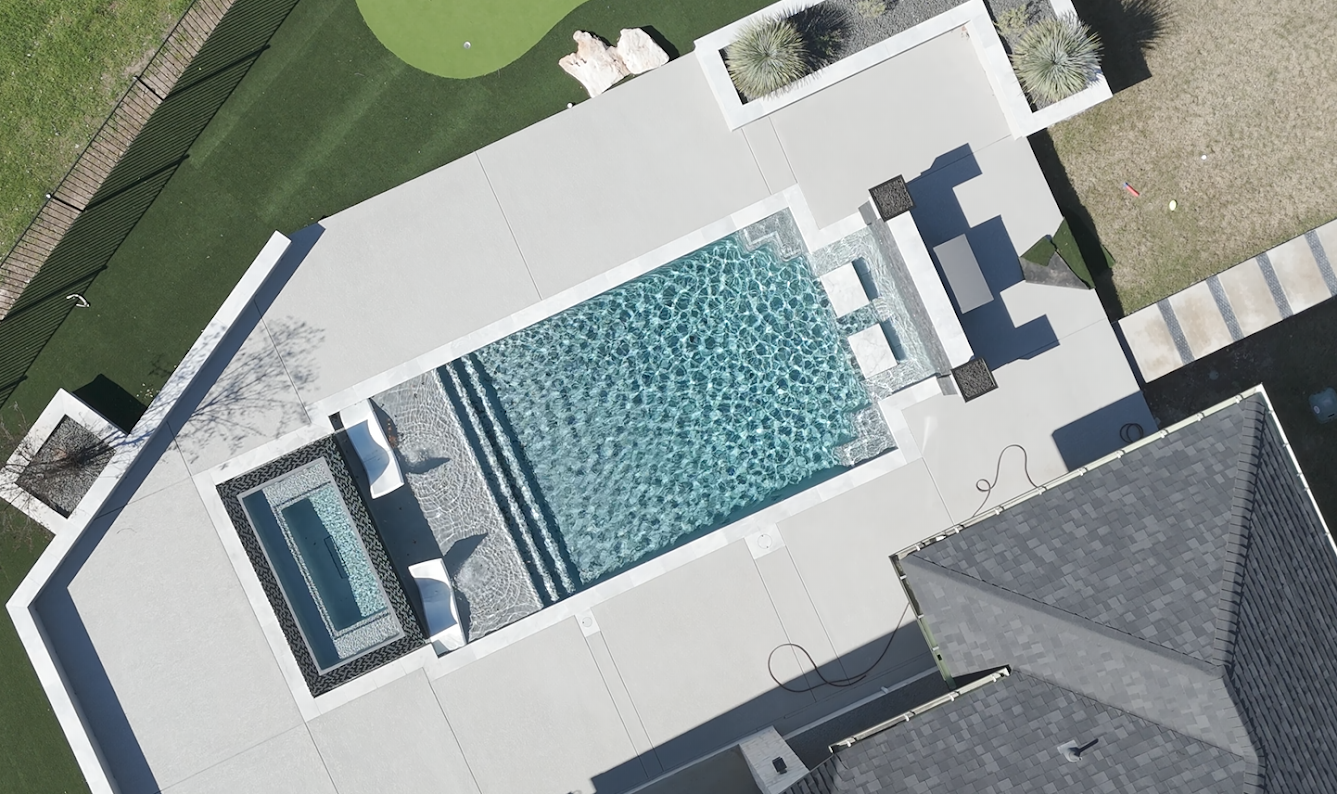
Large acreage lots along the Guadalupe River and rolling hill country make these two communities some of our favorite places to design. Architectural review is thorough, so we submit full site plans and material specs up front — but the payoff is dramatic infinity edges and raised spas that make the most of long Hill Country views. See our full Boerne pool builder page.
Stone Oak & The Dominion (San Antonio)
San Antonio's premier north-side communities sit on rocky, elevated terrain with mature, established lots. Pools here often pair clean geometric lines with resort-style decking and outdoor kitchens to match the neighborhood's upscale architecture. Explore our Stone Oak and The Dominion service pages.
Master-planned suburban communities
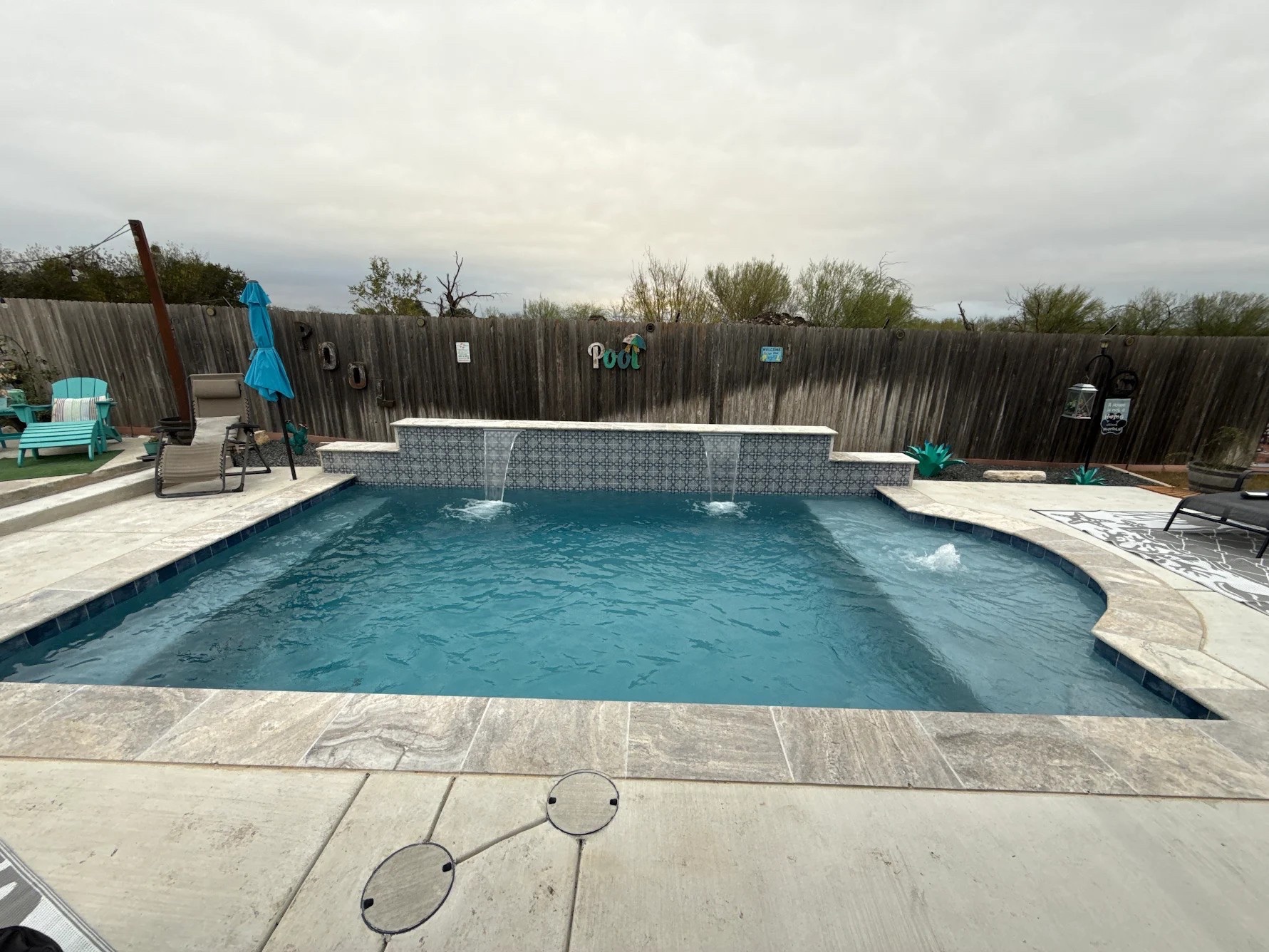
Neighborhoods across New Braunfels and Schertz & Cibolo tend to have flatter, more uniform lots and active HOA design committees. That consistency actually makes for faster approvals — and these lots are well suited to family-friendly layouts: tanning ledges, swim-up bars, and shaded pergolas that get used every day, not just on holidays.
Lakeside & river communities
Canyon Lake, San Marcos, and Wimberley share a wooded, water-adjacent character with rockier, often steeply graded lots. Here we lean on retaining design and multi-level decking to turn a tricky slope into a pool that feels like a private grotto — and since HOA rules are lighter in these areas, there's often more design freedom.
Acreage & rural communities
Spring Branch, Bulverde, and Seguin offer larger acreage with little to no HOA oversight, which is where we get to design the biggest, boldest layouts — full outdoor-living compounds with pools, spas, kitchens, and fire features spread across a generous footprint.
Bulverde & New Braunfels neighborhoods, by name
Within Bulverde and New Braunfels specifically, we've built dedicated guides for the communities homeowners ask about most: Johnson Ranch, Hidden Trails, Ventana, and Belle Oaks in Bulverde; and Vintage Oaks, Veramendi, Meyer Ranch, River Crossing, Copper Ridge, and Havenwood at Hunters Crossing in New Braunfels. See the full list on our neighborhoods page.
What a pool costs in each type of neighborhood
Neighborhood does not set the price of a pool — scope does. But the type of lot a neighborhood is built on nudges the same design up or down by a predictable amount, mostly through excavation, access, retaining, and decking area. Our custom builds start at $60,000, and most mid-range projects land between $75,000 and $150,000 fully finished. Here is how that tends to distribute.
| Neighborhood type | Typical cost driver | What it buys |
|---|---|---|
| Estate & gated ranch | Retaining, engineering, long equipment runs | Vanishing edges, raised spas, view-oriented geometry |
| Master-planned suburban | Tight access, smaller footprint, fence and utility work | Tanning ledges, benches, efficient decking, shade structures |
| Lakeside & river | Rock removal, slope work, multi-level decking | Grotto-like settings, stacked stone, terraced patios |
| Acreage & rural | Utility distance, well and septic layout, scope creep | Full outdoor-living compounds — pool, spa, kitchen, fire feature |
The numbers behind those ranges are broken out line by line in our pool cost guide, and if the budget matters more than the calendar, pool financing is worth reading before you settle on scope. What matters more than any of it: get the exclusions in writing. Vague contract language is what turns a $95,000 pool into a $120,000 pool, and it usually starts with an uncapped rock clause.
Buying a lot with a pool in mind? Ask these first
If you are still choosing a homesite, a fifteen-minute conversation before closing can save five figures later. We are happy to look at a plat with you.
- Where are the easements? Ask for the plat, not a description. Rear drainage easements routinely take eight to ten feet off the usable yard.
- How does water leave the lot? A pool and its decking change drainage. On a lot that already sheds water toward the house, that has to be solved on paper, not after the shell is in.
- What is the side-gate width? Under about eight feet, expect fence removal and hand work.
- Has the builder already scraped the pad? Fill that was placed without compaction documentation has to be dealt with before a shell goes in.
- What does the HOA require, in writing? Ask for the architectural guidelines document, submittal calendar, and review timeline. Committees that meet monthly set your schedule.
Choosing a design that fits your neighborhood
The best pool design respects both your lot and your community's character. A perimeter-overflow edge that stuns in Cordillera Ranch might be overbuilt for a flatter New Braunfels subdivision — and a family-friendly tanning ledge that's perfect in Schertz might undersell a dramatic Canyon Lake view lot. For more on where design ideas fit, see our pool design ideas guide, and for HOA specifics, our permits & HOA guide.
Common questions
What are the best gated communities for a custom pool near San Antonio?
Cordillera Ranch, Fair Oaks Ranch, Stone Oak, and The Dominion are among the most active gated communities for custom pool builds around San Antonio, each with large estate lots suited to resort-style designs.
Do all neighborhoods require HOA approval for a pool?
No. Master-planned and gated communities almost always require HOA architectural review, while rural acreage neighborhoods in places like Spring Branch, Wimberley, and Canyon Lake often have no HOA at all. Our permits and HOA guide walks through both paths.
Which neighborhoods suit an infinity-edge or vanishing-edge pool?
Sloped, view-oriented lots in Cordillera Ranch, Fair Oaks Ranch, Boerne's ranch communities, and hillier parts of Canyon Lake and Wimberley are ideal for infinity-edge and vanishing-edge pool designs. You can see one we built on a falling Boerne lot in the gallery.
See what fits your neighborhood.
We'll walk your lot, talk through your community's rules, and design a pool that belongs there.