
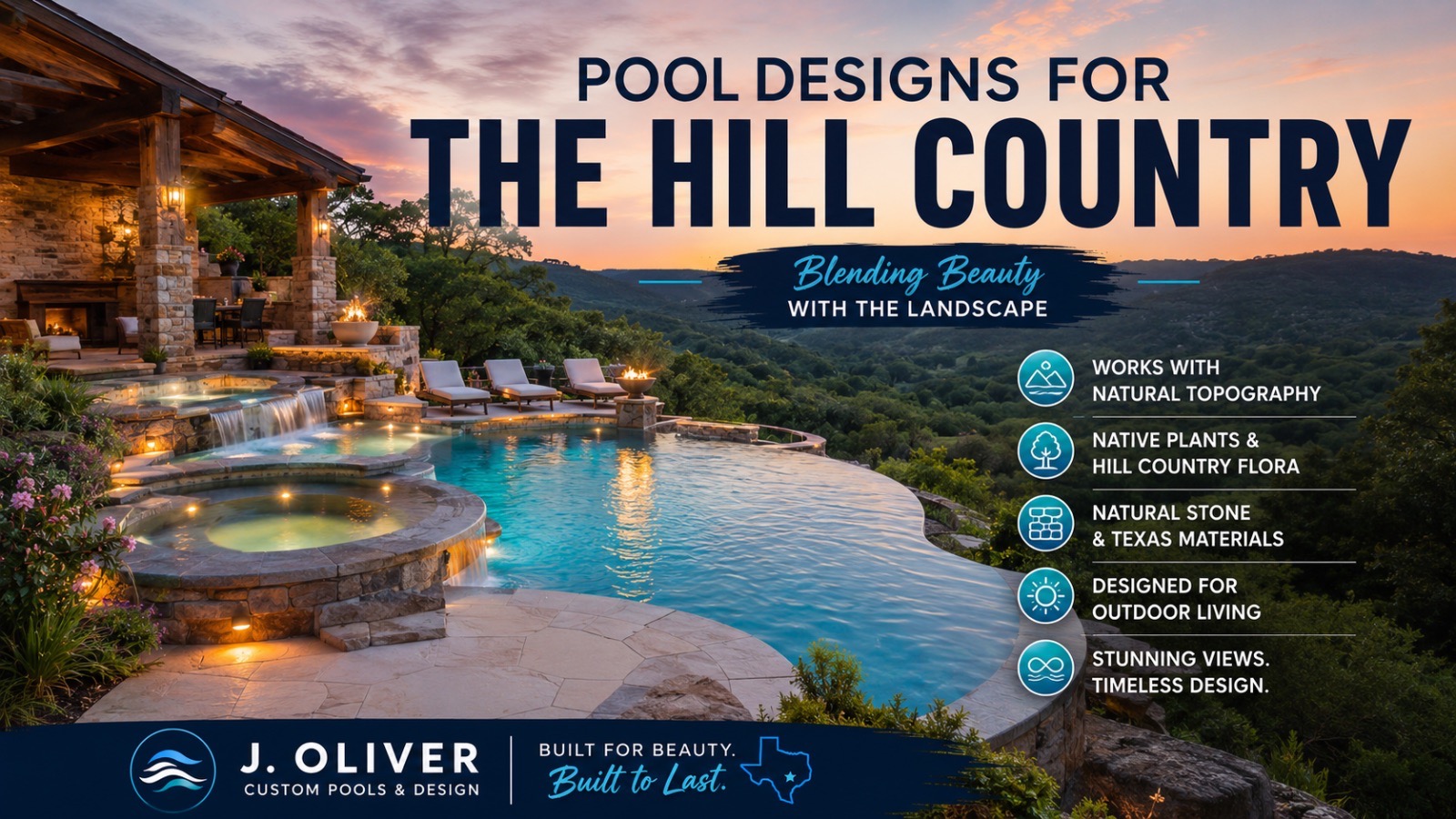
The Texas Hill Country gives you something most backyards don't: elevation, long views, and big skies. The best custom pools use that terrain instead of fighting it. Here are seven design moves we love for lots in New Braunfels, Canyon Lake, Bulverde, and beyond.
1. Vanishing (infinity) edge
On a sloped lot with a view, a vanishing edge makes the water appear to spill into the horizon. It's the single most dramatic move available to a Hill Country backyard — and the grade many of these lots already have is exactly what makes it possible.
Where it works: a lot that falls at least two to three feet across the back of the pool, with something worth looking at beyond it. What it takes: a catch basin below the edge, a second pump dedicated to the wall, engineered retaining, and a longer equipment pad. That structure is most of the cost — the edge itself is the cheap part. What to know: the edge only reads correctly from below or level with the water, so the viewing position matters as much as the view. On a flat lot, a perimeter-overflow design (idea six) achieves a similar effect without inventing a hillside. See a falling-lot example in the gallery.
2. Tanning ledge (Baja shelf)
A shallow sun shelf at the water's surface is perfect for a lounge chair, the kids, or a cool-down on a 100-degree afternoon. Add bubblers and umbrella sleeves and it becomes the most-used part of the whole pool.
Where it works: almost anywhere, which is why nearly every pool we design has one. What it takes: depth of 9 to 12 inches over a footprint wide enough for a chair — about 6 by 12 feet is the size people are happy with a year later. What to know: shallow water heats fast and stays warm, so a ledge in full afternoon sun is bathwater by August. If your yard has no shade on the south or west side, plan an umbrella sleeve or a pergola over that end while the deck is still on paper — retrofitting a sleeve into finished concrete is a demolition job.
3. Raised spa with a spillway
A raised spa does double duty: a warm soak in winter, and a year-round water feature whose spillway pours into the pool. It also adds height and structure to the design, which reads as a more finished, resort-level backyard.
Where it works: best set 12 to 18 inches above the pool so the spillway has something to fall through, and close to the back door — spas nobody walks past in December go unused. What it takes: its own heater, blower, and valve set, and a decision about whether the spa shares water with the pool or runs independently. What to know: the spa's exterior face is the most-photographed surface in the whole backyard. Glass mosaic on that one wall changes the character of the entire design, and it is the single upgrade homeowners tell us they are gladdest they made. Options are covered on our spas and water features page.
4. Grotto & natural stone
Stacked stone, a hidden grotto, and a waterfall lean into the Hill Country's limestone character. Done well, the pool looks like it belongs to the landscape rather than dropped on top of it.
Where it works: lots that already have rock outcrop, mature oaks, or a treed back boundary to build against. What it takes: real stone, set by hand, over a structural shell — and someone who knows how to make the water sheet rather than trickle. What to know: this is the feature most often done badly. The failure mode is a mound of stone sitting in the middle of a flat lawn with a garden-hose flow over it. If your yard has no natural feature to anchor it, a clean glass-tile spillway wall will look more expensive and age better.
5. Fire features
Fire bowls, a fire pit, or a linear fire wall set against the water create the contrast that makes an evening backyard unforgettable — and they extend your season well into the cooler months.
Where it works: anywhere with a gas line, or a propane tank you are willing to site. What it takes: a plumbed gas run sized for the burner, and an ignition choice — match-lit is cheapest, electronic ignition on the automation system is what people actually use. What to know: the gas line is the part that has to be decided early, before decking is poured. Adding one afterward means cutting concrete. Fire bowls on the pool's raised wall photograph better than a detached fire pit, but the sunken fire pit lounge is the one families sit in — we built both into the courtyard project in the gallery.
6. Deck-level (perimeter overflow) design
A perimeter-overflow pool sits flush with the deck and mirrors the sky like glass. It's a clean, modern, architectural look that pairs beautifully with contemporary Hill Country homes.
Where it works: flat lots and contemporary architecture — it is the flat-lot answer to a vanishing edge. What it takes: a slot channel around the entire perimeter, a surge tank sized to the pool's surface area, and construction tolerances measured in fractions of an inch. Level is not a preference here; the effect fails visibly if the coping is off. What to know: it is the most expensive edge treatment in custom pools and the least forgiving to build, which is exactly why it should only be done by a builder who will show you one they finished. It also uses more water, since the whole surface evaporates freely.
7. Full outdoor living
The pool is the centerpiece, but the backyard is the destination. An outdoor kitchen, a covered pergola, and a comfortable lounge area turn a pool into a place you actually live — which is the whole point.
Where it works: any yard with room for a second zone, ideally one with shade by mid-afternoon. What it takes: gas, water, drainage, and power planned with the pool, not after it. What to know: the sequencing is the whole game. Sleeves under decking, conduit for the pergola's fans and lighting, and the kitchen's gas and water stubs cost very little while the yard is open and a great deal once it is finished. Even if the kitchen is phase two, rough it in during phase one. More on how these pieces come together on our outdoor living page.
What these features add to a build
Our custom builds start at $60,000, and most mid-range projects finish between $75,000 and $150,000. Features are where that range comes from. The table below is how these choices tend to move a budget — real numbers depend on size, access, and materials, and every one of them should appear as its own line item on a proposal rather than folded into a lump sum.
| Feature | Budget impact | Must be decided by |
|---|---|---|
| Tanning ledge | Modest — mostly shell and finish area | Design (it is part of the shell) |
| Raised spa & spillway | Significant — added shell, heater, plumbing, tile | Design |
| Vanishing edge | High — catch basin, second pump, retaining | Design, before engineering |
| Perimeter overflow | Highest of the edge treatments | Design, before engineering |
| Fire features | Moderate — driven by the gas run, not the bowls | Before decking is poured |
| Glass tile on a raised wall | Moderate — priced by the square foot | Before tile order |
| Outdoor kitchen & pergola | Varies widely — can rival the pool itself | Rough-in during the pool build |
Full line-item detail lives in our pool cost guide and in what a custom pool costs in New Braunfels.
The three details that decide how the pool looks
Interior finish
The finish sets the water color, and nothing else you choose has as much visual effect. A midnight or deep-blue pebble aggregate reads glassy and bottomless; a lighter blend gives the bright turquoise most people picture when they say "resort." As a PebbleTec Elite builder we work in these aggregates on nearly every build — the comparison is laid out in PebbleTec vs. plaster.
Coping and decking
Travertine stays notably cooler underfoot than concrete in August, which matters in Texas more than any design argument. Stamped or broom-finish concrete costs less and can be beautiful; cut stone in a pattern reads custom. Whatever the material, plan the deck's size around furniture you own, not around a minimum walkway.
Lighting and automation
Color LED lighting in the pool, the spa, and the water feature is what makes the backyard usable after dark, and it is the difference between a pool you look at in the evening and one you swim in. Automation from Pentair, Jandy, or Poolside Tech puts heat, lights, and features on your phone. Both are far cheaper to install during the build than to add later.
Designing for your specific lot
The right combination depends on your slope, your view, your home's architecture, and how you want to use the space. We start every project with a custom 3D design so you can see your backyard before a single shovel hits the ground — and refine it until it's exactly right.
Common questions
What pool features work best on a sloped Hill Country lot?
Sloped lots are ideal for vanishing-edge and perimeter-overflow pools that play off the view, along with raised spas and multi-level decking. The natural grade that makes these lots challenging is exactly what makes those dramatic designs possible.
What is a tanning ledge on a pool?
A tanning ledge, or Baja shelf, is a shallow sun shelf at the water's surface — typically a few inches deep — perfect for lounge chairs, small children, and cooling off. It's one of the most popular and most-used custom pool features in Texas.
Can you see a pool design before building it?
Yes. At J. Oliver Pools we create a custom 3D design of your pool and backyard so you can see and refine the layout, features, and finishes before construction begins.
What features extend the pool season in Texas?
Raised spas, pool heaters, and fire features like fire bowls or a fire pit let you enjoy the backyard well into the cooler months, extending your usable season beyond summer.
Let's design your backyard.
Tell us about your lot and your vision. We'll create a custom 3D design so you can see your backyard before we build it.