
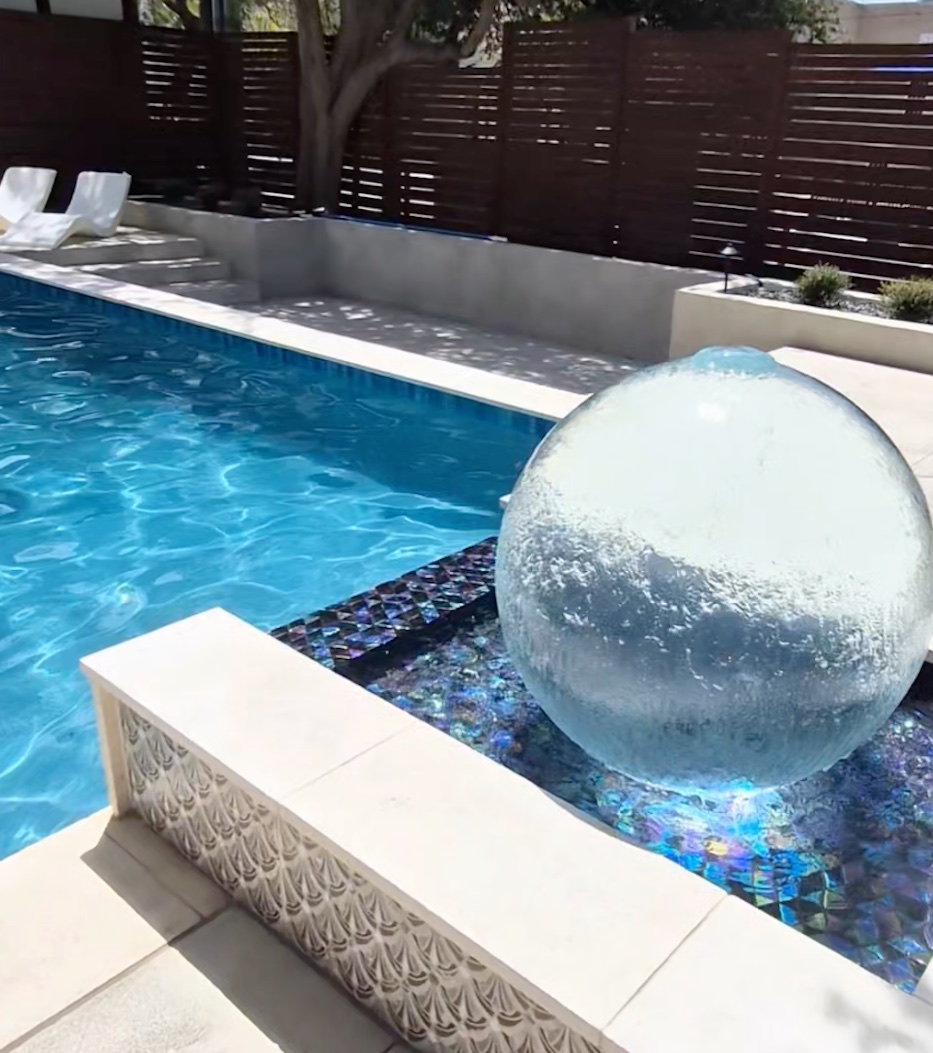
A PAL WaterSphere is a clear acrylic sphere set over a bubbler. Water pumped up through the bubbler fills the sphere and churns inside it all day, and a luminaire under the base lights it in color after dark. It is one of the few water features that works as a sculpture when nobody is swimming.
What you are actually looking at
The sphere is acrylic and permanently full of moving water. Air folded into the flow gives it the frosted, boiling look in the photo above, so from a few feet away it reads like a held wave rather than plumbing. PAL Lighting, whose US operation runs out of Houston, builds the sphere and the bubbler luminaire as a matched pair, and the light is a full-color LED, so the orb can sit warm white for dinner or run color for a party.
Sizes run from about 12 inches to 32 inches. Scale matters more here than with any other feature we install: a small sphere on a wide bond beam disappears, and an oversized one on a narrow ledge looks like it was left there. We size it against the length of the wall it sits on, not against the pool.
Where it belongs in a design
A WaterSphere is a focal point, so it wants a clean stage and a sight line. The placements that have worked best on our builds:
- On a raised bond beam or planter wall at the far end of the pool, so it is the first thing you see from the back door.
- Over a tiled pad — glass mosaic under the sphere throws light back up through the water, which is what gives the feature its depth. The iridescent tile in the photo above is doing real work.
- In a pair, flanking a set of entry steps or a spa, when the yard is symmetrical.
- Off the swim lane. PAL actively discourages mounting the sphere on a sun shelf, and we agree — it belongs out of traffic, where nobody has to swim around it.
It pairs well with quiet water. If the pool already has a sheet-fall wall or a rock waterfall running, the sphere competes for attention. On a still, dark-finish pool it has the stage to itself.
The reason people leave it running
Hardly anyone runs a WaterSphere only for parties. It stays on because of what steady moving water does to a backyard when nothing else is happening in it.
It covers the noise you did not choose
A churning sphere makes a low, continuous, broadband sound, and continuous sound is what masks intermittent sound. On a Hill Country lot that means traffic on 46 or 1863, a neighbor's AC compressor, a dog two fences over. The noise does not go away — it stops being the thing you notice. Same principle as a sound machine in a bedroom, except it is coming from the middle of your yard.
It gives your attention somewhere soft to land
Water that moves without repeating holds the eye without demanding anything from it. Research on blue space — time spent in sight of water — generally reports lower stress and better mood than comparable time spent without it, and water you see every evening counts for more than a lake you visit twice a summer. We build pools, we are not doctors, and we will not pretend a lit sphere is a treatment. What we do hear from clients is that they sit outside longer. That is the part that compounds.
It makes the evening usable
From May through September, most of the time anyone actually spends in a Texas backyard is after sunset. A lit orb with water turning inside it gives a still pool something to do at nine at night. Set warm white and low, it is closer to a fireplace than a fountain.
It is calm without being loud
A rock waterfall or a sheer-descent weir moves far more water, and past a certain volume the sound stops being background and becomes something you talk over. The sphere sits at the quiet end on purpose: enough movement to register from a seat, never enough to raise your voice. The flow control valve is what sets that level, and we tune it with someone sitting in the seating area, not standing at the equipment pad.
What it takes to build one in
The sphere is the easy part. Everything that makes it work is buried before the shell goes in:
- Gunite or concrete only. PAL specifies the WaterSphere for gunite and concrete installations, which is what we build anyway.
- A bubbler niche tied into the steel and set at the right height before the concrete stage, so the sphere finishes flush and level.
- A flow control valve. Pressure at the sphere runs roughly 30–34 GPM, and the difference between a lazy churn and an angry one is a quarter turn of that valve.
- A check valve on the feature line so it does not drain off when the system shuts down.
- A 24-volt transformer for the luminaire, plus conduit run back to the pad and space for it in the automation.
That list is the reason to decide on a sphere during design rather than after, while a new pool build is still on paper. Adding one to a finished pool means opening the deck or the bond beam, which is a job worth doing during a renovation and an expensive one on its own.
Living with it in the Hill Country
Acrylic is softer than glass. It gets washed with water and a soft cloth — no scouring pads, no abrasive cleaners — and light scratches can be polished out rather than lived with. Our limestone-heavy water leaves scale on everything, so the sphere goes on the same wipe-down schedule as the tile line.
When a hard freeze comes through New Braunfels or Boerne, the feature line gets shut down and drained with the rest of the water features. It is the same routine as a bubbler or a deck jet, just with a more expensive part sitting on top of it.
Is it worth it?
A WaterSphere earns its place in a specific situation: a modern pool where the geometry is doing the work and the yard needs one moment of movement, without a rock feature's mass or a fountain's noise. On a naturalistic pool with a grotto and a slide, it is the wrong instrument. We will tell you which one your yard is before you spend money on it.
Common questions
What is a PAL WaterSphere?
The PAL WaterSphere is a clear acrylic sphere mounted over a bubbler. Water pumped up through the bubbler fills the sphere and churns inside it, and a PAL bubbler luminaire underneath lights it in color at night. It is made by PAL Lighting, whose US operation is based in Houston, Texas.
Can a WaterSphere be added to an existing pool?
Yes, if the pool is gunite or concrete. PAL specifies the WaterSphere for gunite and concrete installations only, and the bubbler niche, plumbing, and low-voltage conduit have to be set into the structure. On an existing pool that usually means doing it as part of a renovation, when the deck or bond beam is already open.
Can a WaterSphere go on a tanning ledge or sun shelf?
PAL actively discourages installing the WaterSphere on a sun shelf. We place them on a raised bond beam, a planter wall, or a dedicated tiled pad at the edge of the pool, where the sphere is out of swim traffic and reads as a sculpture.
What does a WaterSphere need for plumbing and power?
Water pressure at the sphere runs about 30 to 34 gallons per minute, so the feature needs a flow control valve to tune it and a check valve so the line does not drain back when the system is off. The luminaire is a 24-volt light and requires a compatible 24-volt transformer.
How do you keep the acrylic sphere clear?
Acrylic is softer than glass, so it is washed with water and a soft cloth, never a scouring pad or an abrasive cleaner. Light scratches from shipping or handling can be polished out. In a Hill Country freeze the feature line should be shut down and drained along with the rest of the water features.
Does a WaterSphere make enough noise to mask traffic or neighbors?
It makes a low, continuous churn rather than a splash, and that kind of steady, broadband sound is what masks intermittent noise like a road or a neighbor's equipment. The flow control valve on the feature line lets us tune the level. By design it is quieter than a rock waterfall or a tall weir.
Which water feature is best if I mainly want a calm backyard?
Something with continuous, moderate movement rather than volume — a WaterSphere, a run of bubblers, or a low sheet fall. All three give steady sound at a level you can talk over. Large rock waterfalls and tall weirs move much more water and can end up working against the calm you wanted.
See the rest of what we build into the water on our spas and water features page, or start with the design ideas that suit Hill Country lots.
Want one in your design?
We will show you the sphere in your 3D design, sized to the wall it sits on, with the plumbing and lighting written into the quote.