
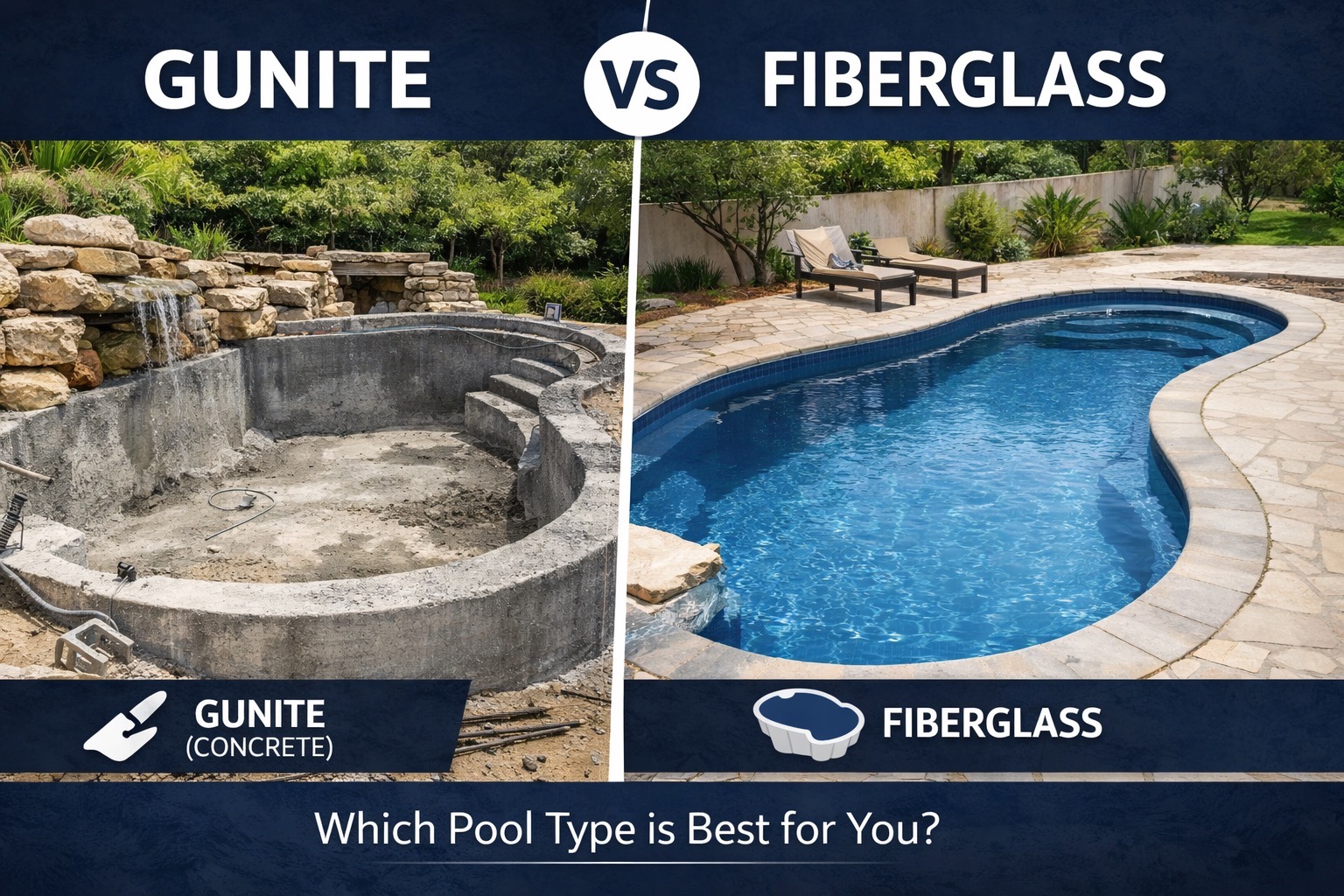
There are three main ways to build an in-ground pool: gunite (sprayed concrete), fiberglass, and vinyl-liner. All three work in Texas — but they are not equal. Gunite costs more upfront and is the most durable and fully customizable option, which is why it dominates high-end custom backyards across the Hill Country. Here is how the three really compare.
Gunite (concrete) pools
Gunite pools are built by spraying a steel-reinforced concrete shell directly into an excavated hole, then finishing it in plaster or PebbleTec. Because the shell is formed on site, there is no limit on shape, size, or depth — and features like raised spas, tanning ledges, vanishing edges, and grottos integrate seamlessly.
- Design freedom — any shape, any depth, any feature. This is the reason custom builders use it.
- Durability — a properly engineered gunite shell lasts for decades and stands up to Texas soil movement.
- Resale appeal — a custom gunite pool reads as a permanent, premium improvement.
- Trade-offs — highest upfront cost and the longest build time, and the plaster finish is refreshed every 10–15 years.
Fiberglass pools
A fiberglass pool is a pre-molded shell manufactured in a factory and lowered into the ground in one piece. Installation is fast and the smooth gel-coat surface is easy on the feet and low-maintenance.
- Fast install — often dropped in and running within a couple of weeks.
- Low maintenance — the non-porous surface resists algae and uses less chemicals.
- Trade-offs — you are limited to the manufacturer's shapes and sizes, large shells are hard to truck down narrow Hill Country roads, and the shell can shift in expansive clay soils if not installed carefully.
Vinyl-liner pools
A vinyl pool uses a steel or polymer wall frame with a custom-fit vinyl liner. It is typically the lowest upfront cost of the three, which makes it attractive on a tight budget.
- Lowest upfront price — the cheapest way into an in-ground pool.
- Soft surface — the liner is smooth to the touch.
- Trade-offs — the liner needs replacing every 7–12 years (a recurring cost), it can be torn, and the design options are the most limited of the three.
The three side by side
Most of the differences come down to how the shell is made. Everything else — cost, lifespan, what you can build — follows from that one decision.
| Gunite | Fiberglass | Vinyl liner | |
|---|---|---|---|
| Shell | Steel-reinforced concrete sprayed on site | Factory-molded, delivered in one piece | Wall frame with a fitted liner |
| Shape and depth | Unlimited | Manufacturer's catalog only | Mostly rectangular, limited depth |
| Integrated spa, ledge, vanishing edge | Yes, monolithic with the pool | Only where the mold offers it | Rarely practical |
| Time in the yard | Longest — the shell cures and the finish is applied on site | Shortest | Short |
| Upfront cost | Highest | Middle | Lowest |
| Recurring cost | Finish refreshed every 10–15 years | Gel coat can be refinished; no scheduled replacement | New liner every 7–12 years |
| Best fit | A permanent, one-of-a-kind backyard | A simple pool, fast, on a lot with wide access | The lowest possible entry price |
What Hill Country ground does to the decision
Soil is the part of this comparison homeowners hear least about and feel most. Much of Comal, Kendall, and northern Bexar County sits on expansive clay over limestone. The clay swells when it rains and shrinks when it bakes, and it moves the same way under a pool as it does under a foundation.
- Gunite is engineered per lot. Steel schedule, shell thickness, and beam detail are specified for the soil in your yard. On rock, that means the excavation cost is real and should be priced honestly — not left as an open clause.
- Fiberglass depends on backfill. The shell itself is strong, but it relies on the material packed around and under it. Careless backfill in moving clay is where you get shifting and bulging.
- Vinyl depends on the wall frame staying square. Movement shows up as wrinkles and stressed seams.
Limestone shelf is common here, and hitting it changes excavation, not the shell type. Ask any builder how rock is handled in the contract before you compare prices — an uncapped rock clause is the most common way a quoted number stops being the real number.
Cost over twenty years, not on install day
Ranked by upfront price, the order is vinyl, then fiberglass, then gunite. Over two decades the gap narrows, because each system carries a different recurring bill.
- Vinyl takes one or two liner replacements in that window, plus the labor and water each time.
- Fiberglass has no scheduled replacement, but a faded or crazed gel coat is a specialist refinish, and the shell cannot be reshaped later.
- Gunite gets a new finish every 10–15 years. A PebbleTec surface stretches that interval, and the same visit is when most owners update tile, coping, and equipment.
Sanitizing, pumping, and heating cost roughly the same regardless of shell type, and they add up to more than any of these differences. Our pool cost guide breaks the build itself down line by line.
Access and logistics
A fiberglass shell arrives on a truck and has to be craned into place. On a Hill Country lot with a narrow drive, mature oaks, a steep slope, or a gated entry, the crane reach and the truck route decide whether the shell you want can physically get to the hole. Gunite arrives as a hose. That is not a small advantage on tight sites, and it is often what settles the question before design begins.
Renovating what you already have
Shell type also decides what a remodel can do. A gunite pool can be re-shaped, deepened, given a raised spa, or converted to a vanishing edge during a renovation. A fiberglass shell is the shape it was molded as, permanently. A vinyl pool can get new coping and decking, but the pool stays the pool. If you expect your backyard to evolve, that difference matters more than install week.
Which is right for a Texas backyard?
If you want a one-of-a-kind, resort-level backyard that lasts for decades, gunite is the clear answer — and it is what we build at J. Oliver Pools. Fiberglass can be a sensible choice for a simple, low-maintenance pool on a lot with good access. Vinyl makes the most sense when upfront budget is the deciding factor and you are comfortable with the recurring liner cost.
The Hill Country's expansive clay soils are the deciding factor for many homeowners: a properly engineered gunite shell is built to move with the ground and stay true, which is why it remains the standard for serious custom work in New Braunfels, Canyon Lake, Bulverde, and San Antonio.
Common questions
Which pool type lasts the longest?
A properly engineered gunite pool lasts the longest — typically decades — with the plaster or PebbleTec finish refreshed every 10 to 15 years. Fiberglass shells and vinyl liners have shorter functional lifespans, and vinyl liners need replacing every 7 to 12 years.
Why is gunite the most popular pool in Texas?
Gunite allows unlimited shape, size, depth, and features, and a properly engineered shell stands up to the expansive clay soils common in the Texas Hill Country. That combination of design freedom and durability is why it dominates custom pool building in the region.
Is fiberglass or gunite better for expansive clay soil?
Both can work, but gunite is generally preferred on expansive clay because the shell is engineered and reinforced for your specific lot. Fiberglass shells can shift in moving soils if not installed and backfilled carefully.
What is the cheapest in-ground pool to install?
Vinyl-liner pools usually have the lowest upfront cost, followed by fiberglass, then custom gunite. Keep in mind vinyl liners carry a recurring replacement cost every 7 to 12 years.
If gunite is where you are landing, our new pool construction page covers how we build, and the week-by-week timeline shows what the schedule really looks like.
Not sure which pool fits your yard?
Tell us about your lot and how you want to use your backyard. We'll recommend the right approach and put together a transparent, itemized quote.