
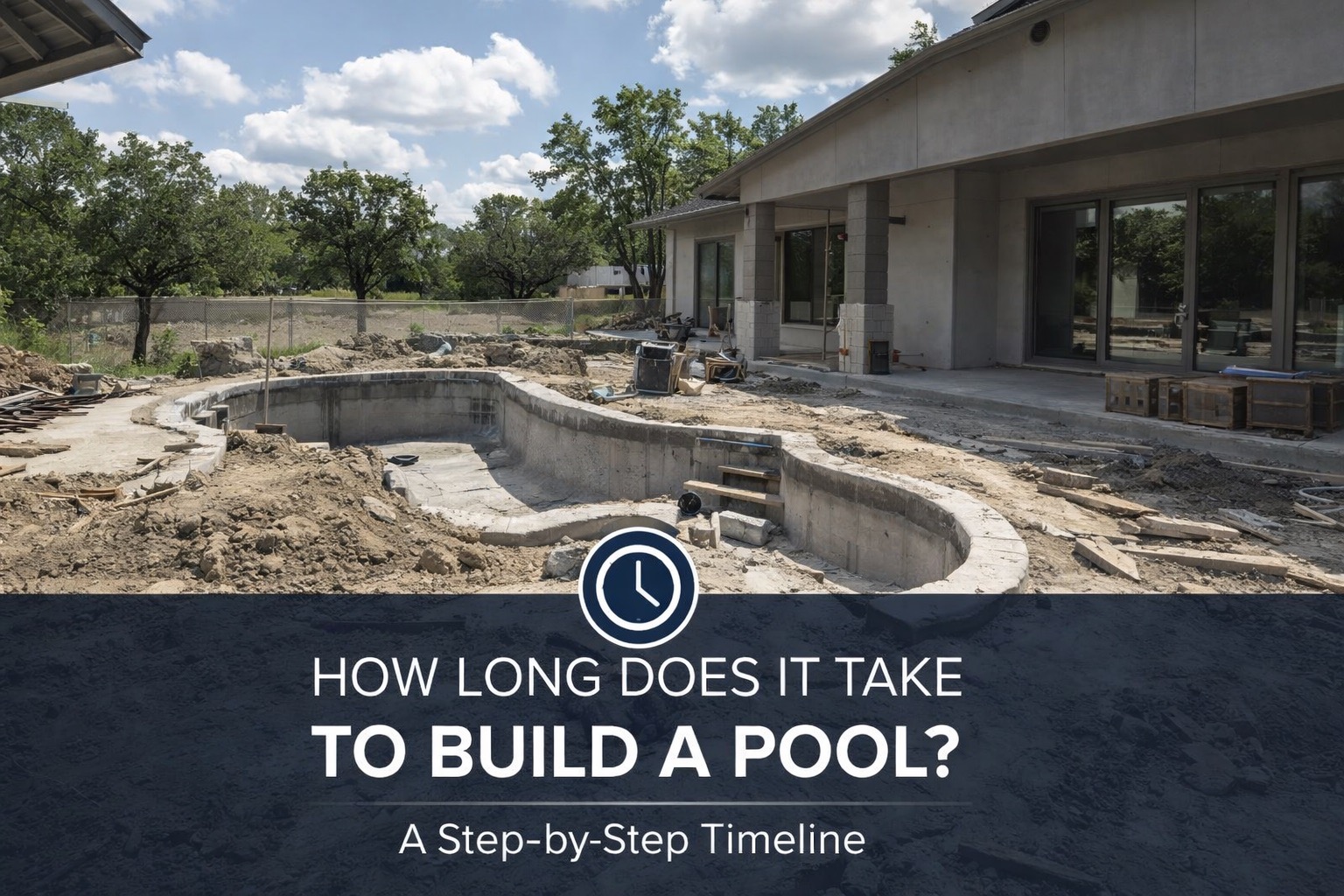
Most custom gunite pools take about 8 to 14 weeks of active construction from the first dig to your first swim, with design and permitting adding a few weeks before that. Weather, inspections, and feature complexity all move the number. Here is what each stage actually involves.
Before the dig: design & permitting (2–6 weeks)
Every great pool starts on paper. We finalize your custom 3D design, agree on finishes and features, then handle engineering, permits, and any HOA approvals. This phase varies the most — city and county permitting and HOA review timelines are partly out of any builder's hands, which is why starting early matters.
Week 1–2 — Layout & excavation
We stake out the pool, confirm the design on the ground, and excavate. On Hill Country lots this is where limestone or rock can add time, but it also gives a stable base. By the end of this stage the shape of your pool is literally in the ground.
Week 2–4 — Steel, plumbing & gunite
Crews tie the steel rebar cage, rough in the plumbing and electrical conduit, and then spray the gunite shell. After the shell is sprayed it has to cure for several weeks — this curing window is essential to a durable pool and cannot be rushed.
Week 4–8 — Tile, coping & decking
While the shell cures, the build moves to the finishes that define the look: waterline tile, coping, and your decking — travertine, pavers, or stamped concrete. Any outdoor living elements like an outdoor kitchen, fire features, or a pergola come together in this stretch.
Week 8–12 — Equipment, plaster & startup
The equipment pad — pump, filter, heater, and automation — is set and wired. Then the interior finish (plaster or PebbleTec) goes on, the pool is filled, and we begin the startup and water-balancing process. This is the home stretch before your first swim.
What can change the timeline
- Weather — heavy Texas rain pauses excavation, gunite, and plaster.
- Permits & HOA — approval times vary by city, county, and neighborhood.
- Site conditions — rock, slope, and access can add excavation time.
- Feature complexity — vanishing edges, raised spas, and grottos add stages.
At J. Oliver Pools we keep you informed at every phase, so you always know what is happening this week and what comes next. A realistic schedule set up front — and communicated clearly — is one of the biggest differences between a smooth build and a stressful one.
The whole build on one page
Stages overlap, and the week numbers below shift with weather and inspections. What does not change is the order: nothing can start until the stage before it passes.
| Stage | Typical duration | What holds it up |
|---|---|---|
| Design and 3D revisions | 1–3 weeks | Decisions. Finish and feature choices you have not made yet |
| Engineering, permit, HOA | 2–6 weeks | Review queues and ARC meeting dates |
| Layout and excavation | 2–5 days | Rock, access for the machine, wet ground |
| Steel, plumbing, electrical rough-in | 1–2 weeks | Inspection scheduling |
| Gunite and cure | 1 day to shoot, then weeks of cure | Nothing. This one cannot be compressed |
| Tile, coping, decking, outdoor living | 2–4 weeks | Material lead times, rain on mortar work |
| Equipment set and wiring | 3–7 days | Heater or automation backorders, final electrical inspection |
| Interior finish, fill, startup | 1 week to finish and fill | Applied in one day; the water then needs daily attention |
Permitting is local, and it varies
The paperwork phase is the least visible and the most variable. Inside New Braunfels city limits you are dealing with the city; on unincorporated Comal County land it is a different process; Boerne, Bulverde, Fair Oaks Ranch, and San Antonio each run their own. Add an HOA architectural review on top of it in most of the neighborhoods we build in, and committees that meet monthly set your start date more than our schedule does.
Our permits and HOA guide covers what each jurisdiction asks for. The practical advice: get plans in front of your ARC the moment the design is signed, and ask when the committee actually meets.
Season matters more than most people expect
Hill Country winters are mild enough to build in, and the off-season is quietly the best time to start. Crews are less booked, permit queues are shorter, and a build that begins in October is swimmable well before Memorial Day. Start the same project in April and you are competing with every other homeowner who decided the same thing in the first warm week.
Summer brings its own delay: heat limits when plaster and mortar can be worked, and an afternoon storm can stop a gunite day outright. Nobody controls that. What a builder can control is telling you about it the day it happens.
What you can do to keep it moving
- Choose finishes before excavation. Tile, coping, decking, and interior finish selections made early stop the build from waiting on you.
- File the HOA application immediately. It costs nothing to be early in the queue.
- Clear site access. Gates, fence panels, and irrigation lines in the equipment path are worth handling before the machine arrives.
- Decide on outdoor living now, not later. A kitchen, pergola, or fire feature added mid-build means re-plumbing, re-wiring, and re-pouring.
- Plan for utilities. Gas runs and electrical panel upgrades have their own inspection cycles.
After the water goes in
Filling the pool is not the last day. A new plaster or PebbleTec finish needs a startup process: brushing on a schedule, careful chemistry, and no heavy chemicals while the surface hardens over roughly the first month. Skipping it is how new pools end up with staining and scale in year one. We walk you through the equipment, the automation, and the first month of water care before we hand it over.
Frequently asked questions
How long does it take to build a custom pool in Texas?
Most custom gunite pools take about 8 to 14 weeks of active construction from excavation to first swim, with an additional 2 to 6 weeks beforehand for design, engineering, permitting, and HOA approval. Weather, site conditions, and feature complexity affect the total.
Why does a gunite pool take longer than fiberglass?
A gunite pool is built and cured on site stage by stage — excavation, steel, gunite, cure, tile and decking, then plaster and startup. Fiberglass shells are pre-made and dropped in, so they install faster, but they cannot match gunite's custom shapes, features, and durability.
What slows down a pool build the most?
Weather and permitting are the two biggest variables. Heavy rain pauses excavation, gunite, and plaster work, while city, county, and HOA approval timelines are partly outside a builder's control — which is why we start the paperwork as early as possible.
Can you build a pool in the winter in Texas?
Yes. The Texas Hill Country's mild winters allow year-round construction, and starting a build in the off-season often means your pool is ready to enjoy by the time summer arrives.
For what the build itself costs stage by stage, see our pool cost guide and how we build. And before you sign anything, read what vague contract language costs Hill Country homeowners — schedule promises without a written scope are the ones that slip.
Ready to start your build?
The sooner we start design and permitting, the sooner you're swimming. Tell us about your project and we'll map out a realistic timeline for your backyard.