
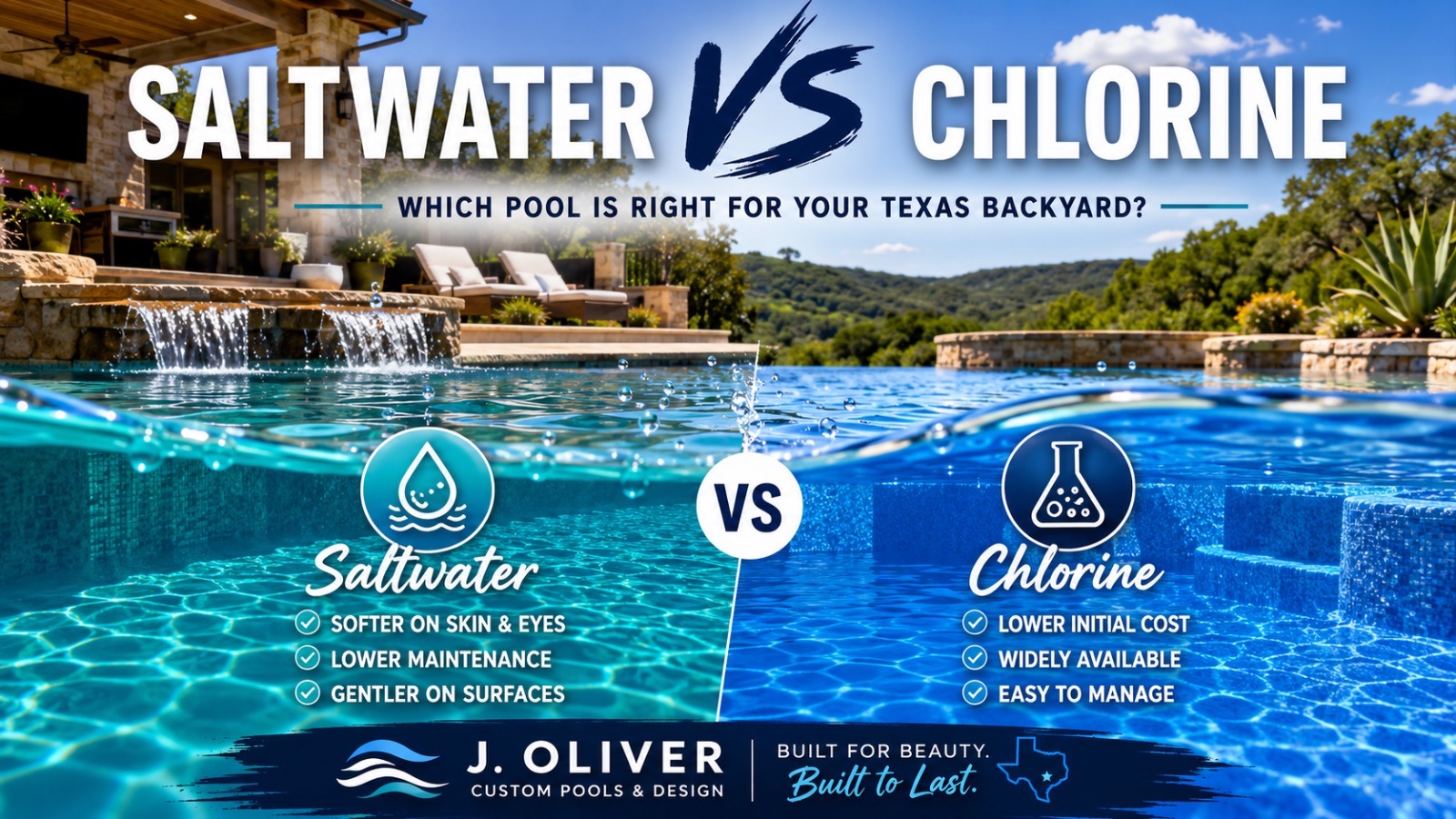
A saltwater pool costs more upfront but less to run year to year, while a traditional chlorine pool is cheaper to install but typically costs more in ongoing chemicals. Both are sanitized with chlorine — the real difference is how that chlorine is produced. Here is how they compare for a Texas backyard.
First, a common myth
A "saltwater pool" is not chlorine-free. A salt-chlorine generator simply makes its own chlorine from dissolved salt, instead of you adding chlorine by hand. The water is far less salty than the ocean — closer to a soft teardrop — and many owners describe it as gentler on skin, eyes, and swimsuits.
Upfront cost
A chlorine pool wins on day one. You only need a standard pump and filter. A saltwater pool adds a salt-chlorine generator (the salt cell), which raises the initial equipment cost. On a new custom build the difference is a modest line item relative to the whole project, and it is easy to add during construction.
Ongoing cost & upkeep
Saltwater
- Lower chemical spend — the generator produces chlorine from inexpensive salt, so you buy far fewer chemicals.
- Less hands-on — more consistent sanitizing with less daily fuss.
- The catch — the salt cell is a wear part that's typically replaced every 3–7 years, and salt can be tougher on some natural stone and metal fittings if not managed.
Chlorine
- Cheaper equipment — no cell to buy or replace.
- Higher chemical cost — you buy and add chlorine regularly, and Texas heat burns through it faster in summer.
- More attention — levels need checking and adjusting more often.
Five years of ownership, side by side
The honest comparison is not the price of the equipment, it is what the pool costs to run once the water is in it. Below is the shape of that comparison for a mid-sized Hill Country pool. Real numbers move with pool size, sun exposure, how heavily the pool is used, and what chemicals cost that season.
| Cost | Saltwater | Traditional chlorine |
|---|---|---|
| Equipment at build | Adds a salt-chlorine generator and cell | Standard pump and filter only |
| Sanitizer per season | Low — a few bags of pool salt a year | Higher — tabs or liquid chlorine all season |
| Balancing chemicals | Still needed — acid demand runs higher, since the cell pushes pH up | Still needed — plus stabilizer creep from tabs |
| Wear parts | Salt cell every 3–7 years | None specific to sanitizing |
| Weekly attention | Check salt and pH; the generator handles dosing | Add chlorine and test, more often in July and August |
| Five-year total | Usually lower, even counting one cell replacement | Usually higher, and rises with chemical prices |
Whichever system you choose, the rest of the operating cost is identical and larger than either: pumping, heating, water, and filtration. A variable-speed pump on a sensible schedule saves more money in a year than the difference between these two sanitizing methods.
What salt actually does to materials
This is the legitimate concern, and it is a specification question rather than a reason to avoid salt. Lightly salted water is corrosive to a few specific things over time, and all of them are choices made during the build.
- Natural stone coping and decking. Splash-out evaporates and leaves salt behind, which can etch or spall softer stone. Sealing the stone and rinsing the deck handles it; dense travertine and properly sealed cut stone hold up well.
- Metal fittings, rails, and light rings. Specify stainless of the right grade, and keep sacrificial anodes in the system. Mixed or cheap metal is what fails.
- Heaters. Use a heater rated for salt systems with a cupronickel heat exchanger. This is a spec line, not an upgrade to argue about.
- Landscaping near splash-out. Salt-tolerant planting along the deck edge, and grading that keeps splash-out from pooling in beds.
- Automatic covers and hardware. Rinse tracks; choose corrosion-rated hardware.
None of that is exotic. It does mean the decision has to be made before materials are ordered — which is the real argument for choosing your sanitizing system at design, not after the shell is in the ground.
Retrofitting an existing pool
Converting a chlorine pool to salt is a straightforward job: add the generator and cell at the equipment pad, plumb it in, and add salt. The parts to check first are the ones above — the heater's heat exchanger, the condition and sealing of stone coping, and any rails or fittings already showing corrosion. If your pool is due for a resurface anyway, converting during a renovation is the efficient time to do it, since the equipment pad and the finish get addressed together.
Neither system is a substitute for circulation
Most water problems homeowners blame on their sanitizer are actually circulation, filtration, or pH. Chlorine, however it is produced, does very little at high pH. If a pool goes cloudy or green every August, the fix is usually run time, a clean filter, and pH control — not switching systems. Automation from Pentair, Jandy, or Poolside Tech makes that easier by running the pump on a schedule and reporting when something is off.
The Texas factor
Long, hot Hill Country summers mean pools get heavy use and chlorine demand spikes. That's a point in saltwater's favor — the generator keeps up automatically while you enjoy the pool. For finishes, we plan material choices and fittings around a salt system from the start, which avoids the wear concerns entirely.
So which should you choose?
If you want lower year-round upkeep and a softer feel, and you're building custom anyway, saltwater is usually worth the upfront cost. If keeping initial cost as low as possible matters most, a traditional chlorine system is perfectly good. Either way, we'll spec the equipment correctly for your pool and walk you through what ownership really looks like before you decide.
Common questions
Is a saltwater pool cheaper than a chlorine pool?
A saltwater pool usually costs more upfront because of the salt-chlorine generator, but it typically costs less year to year since it makes its own chlorine from inexpensive salt. A chlorine pool is cheaper to install but costs more in ongoing chemicals.
Are saltwater pools chlorine-free?
No. Saltwater pools are still sanitized with chlorine — a salt-chlorine generator produces it automatically from dissolved salt, rather than you adding chlorine by hand. The water is only lightly salted and feels gentler on skin and eyes.
How often do you replace a salt cell?
A salt-chlorine cell is a wear part that's typically replaced every 3 to 7 years depending on use and maintenance. Factoring in that replacement, saltwater systems still tend to cost less to operate over time than buying chlorine continuously.
Is saltwater or chlorine better for hot Texas summers?
Saltwater has an edge in the Texas heat because the generator keeps producing chlorine automatically as demand spikes with heavy summer use, while a chlorine pool needs more frequent manual dosing in the same conditions.
For what a full build costs and what ownership looks like beyond sanitizing, see our pool cost guide, and get the equipment and exclusions written into the proposal — vague contract language is where ownership costs hide.
Building new? Let's spec it right.
We'll recommend the best sanitizing system for how you'll use your pool and build it into a transparent, itemized quote.